Chilled Water System Iron Removal and Hydronic Flushing
ICCI approaches chilled water system flushing as a controlled cleaning and water-quality restoration process rather than simply a high-volume drain-and-fill operation. The objective is to remove suspended iron, iron oxides, corrosion products, construction debris, and other particulate contamination from the hydronic system while protecting chillers, heat exchangers, pumps, control valves, coils, and other sensitive components. Particular attention is given to maintaining sufficient circulation velocity and filtration capacity to mobilize and capture particulate matter. Filtration and mechanical removal of suspended solids are recognized best practices for closed hydronic systems because iron oxide and mill-scale particles can contribute to fouling, abrasion, and damage to valves, seals, and heat-transfer equipment.
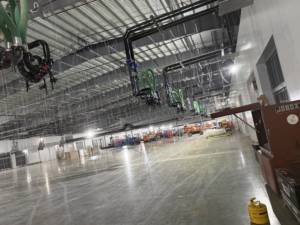
Prior to initiating the cleaning circulation, ICCI establishes a temporary flushing configuration designed specifically for the system being cleaned with a large amount of owned equipment. This includes installing appropriately sized jumpers and bypasses around chillers, coolers, heat exchangers, and other equipment that should not be exposed to the initial high-solids flushing water or cleaning chemistry. Temporary piping is arranged to create effective flow paths through the distribution system, eliminate stagnant areas where practical, and allow individual branches, risers, coils, and other sections to be flushed and verified. ICCI evaluates the system hydraulically to ensure that the temporary configuration provides meaningful circulation through the areas requiring cleaning rather than simply recirculating water through the path of least resistance.
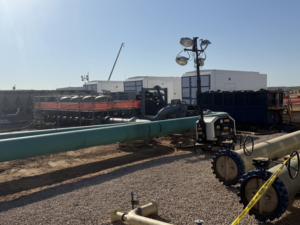
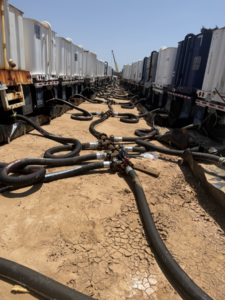
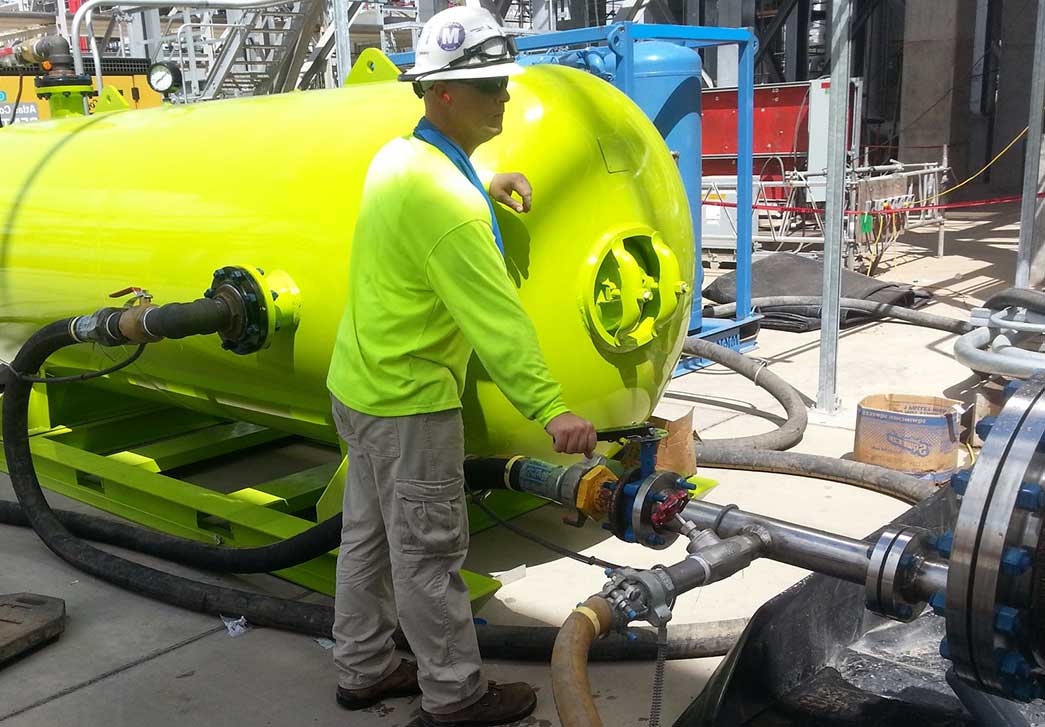
ICCI supplies and operates a comprehensive temporary circulation, filtration, sampling, and testing system. Depending upon the size and condition of the installation, this equipment may include temporary high-capacity circulation pumps, filtration skids, strainers, bag and cartridge filtration, magnetic separation technology, chemical feed equipment, flow meters, pressure gauges, differential-pressure monitoring, water meters, air venting, sampling stations, tanks, hoses, temporary piping, and other specialized equipment. Filtration is selected and staged according to the anticipated particulate loading and particle-size distribution, with progressively finer filtration employed as the system becomes cleaner. This approach allows heavy contamination to be removed efficiently without unnecessarily plugging fine filtration media during the initial cleaning stages.
A critical component of ICCI’s process is verification of actual system circulation. Flow is measured and documented at appropriate locations so that the cleaning process is based on demonstrated hydraulic performance rather than assumptions regarding pump capacity. ICCI monitors flow, pressure, filter differential pressure, temperature, pH, conductivity, turbidity, dissolved and/or total iron, and other water-quality parameters appropriate to the project such as concentration levels of the treatment chemistry. The flushing process continues until the water-quality results demonstrate that the iron and particulate levels meet the acceptance criteria established by the customer, engineer, water-treatment consultant, or project specifications.
Chemical Cleaning, pH Adjustment and Passivation
Where chemistry is required to enhance particulate removal, ICCI develops a treatment program based upon system metallurgy, existing water chemistry, contamination levels, operating conditions, and the customer’s acceptance requirements. pH is adjusted and controlled within a range appropriate for the system’s materials of construction and the selected cleaning chemistry. Surfactants, dispersants, and other compatible cleaning agents may be injected to help loosen, suspend, and transport iron oxides, corrosion products, biofilm-associated deposits, and other contaminants so that they can be captured by the temporary filtration system rather than redeposited elsewhere in the piping.
Following the primary particulate-removal phase, ICCI can introduce an appropriate passivation and corrosion-inhibition program to establish protective films on exposed metallic surfaces. Passivation chemistry is selected and controlled in accordance with the system metallurgy and chemical manufacturer’s requirements. The purpose is to transition the system from an actively cleaned condition to a chemically stabilized condition while minimizing the opportunity for renewed corrosion.
After the cleaning and passivation stages, ICCI can perform a controlled biocide treatment where appropriate. The biocide program is selected based on the system’s biological conditions, materials compatibility, discharge requirements, and customer specifications. Where appropriate, surfactant or biodispersant chemistry may be incorporated to improve contact with deposits and biological material. The treatment is circulated for the required contact period, followed by verification testing.
Continued Circulation and Verification
ICCI’s work does not necessarily end when the initial flushing water becomes visually clean. Continued controlled circulation following the primary flushing operation allows residual particulate matter to be captured and provides an opportunity to identify contamination that may be released from low-flow areas, dead legs, branch circuits, coils, or other portions of the system as circulation conditions change. ICCI can maintain temporary circulation and filtration after the primary cleaning phase while monitoring water chemistry and iron concentrations until the system demonstrates stable water quality.
On-site analytical chemistry is an integral part of ICCI’s process. ICCI personnel can perform field analysis of key parameters during the cleaning operation, allowing chemical adjustments and operational decisions to be made based on actual system conditions. Samples can also be submitted to qualified third-party laboratories for independent verification of iron concentration and other specified water-quality parameters. Final acceptance is based on the customer’s defined specifications and documented analytical results rather than visual appearance alone.
The final objective is a demonstrably clean and chemically stable chilled water system. ICCI documents the flushing sequence, circulation conditions, filtration activity, chemical treatment, sampling results, iron concentrations, and final water-quality parameters so that the customer receives objective evidence that the system has achieved the agreed-upon cleaning criteria. The result is a professional, documented cleaning process designed to restore system cleanliness, protect critical equipment, support efficient heat transfer, and establish an appropriate foundation for long-term corrosion and biological control.